


By Lucille Lang Day. Blue Light Press, 2020.
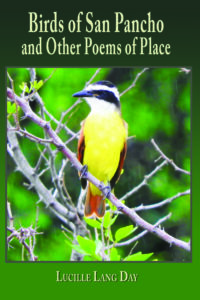 “The seventy-four poems in Lucille Lang Day’s Birds of San Pancho and Other Poems of Place take the reader on a journey across continents, seas, and time itself. Charged with a lyricism that is at the same time tough and vulnerable, they recreate and preserve images of a beauty that is on the verge of disappearing or has already disappeared. Sometimes it is the beauty of the rain forests of Costa Rica or the birds of the Galápagos or that of cities like Athens, San Miguel de Allende, or Venice in flood. Sometimes it is a beauty that exists only in a single word such as ‘Oregon, . . . from wauregan, an Algonquian word for “beautiful river.”‘ Day is a painterly poet, with a finely honed sense of color and strong command of concrete detail, yet for all the beauty she evokes, she does not shy away from difficult topics like global warming, genocide, regret, loss, and death. The result is a remarkable collection of poems that are deeply layered, deeply felt, and deeply moving.”
— Mary Mackey, author of The Jaguars That Prowl Our Dreams: New and Selected Poems, winner of the 2019 Eric Hoffer Award for Best Book Published by a Small Press
“Very few poets possess the acute observational power on display in Lucille Lang Day’s Birds of San Pancho. In lyric, narrative, and meditative forms, Day’s curiosity and love for the world radiate from every page. The life affirming vision in this book makes it a perfect read for our fraught time.”
— David Roderick, Author of Blue Colonial and The Americans, cofounder and codirector, Left Margin LIT
“What a rich and celebratory book is Lucille Lang Day’s Birds of San Pancho. A trained scientist as well as a prolific poet and anthologist, she brings to her experience a vast curiosity, an intimate knowledge of flora and fauna, and a keen appreciation for the things of this world—travel, food, weather, the manifold creatures, love. Yet hers is no simple happiness. Behind it lies a full awareness of environmental damage, as in ‘What Flows Into the Gulf of Mexico,’ with its copious lists of pollutants and poisons. Behind it, too, lies the knowledge of death, as in the beautiful elegies ‘Hologram,’ for her daughter Liana, and ‘Old Man,’ for a long-ago lover named Bill. ‘Take my hand,’ she says to her dying friend. ‘Let’s remember the sun beating on slushy snow / and how you skied all the way down / the intermediate slope without falling.’”
— Ann Fisher-Wirth, author of The Bones of Winter Birds and Mississippi, coeditor of The Ecopoetry Anthology
“Birds thread these pages, but there are also poems about landscape, art, travel (Mexico, Costa Rica, the Galápagos, various countries in Europe, and America ‘between the two shining seas’). Lucille Lang Day looks at a bird and wonders ‘about the meaning of each moment / and how to hold it the way / Monet and van Gogh / caught haystacks and orchards / in particular seasons and light.’ The language is simply gorgeous throughout the book: ‘The ocean, a turquoise taffeta shawl, / falls on sand shoulders lit by a moon / radiant as a trillion-ton pearl / on a silken scarf of pink and maroon.’ There are also heartbreaking poems about the death of her daughter and other losses. One poem ends, ‘igniting a blaze of amazement,’ and that is what this book does, with poem after poem making us aware of the glories of the natural world which we are rapidly losing, forcing us to wake up, and go down on our knees in awestruck wonder.”


