

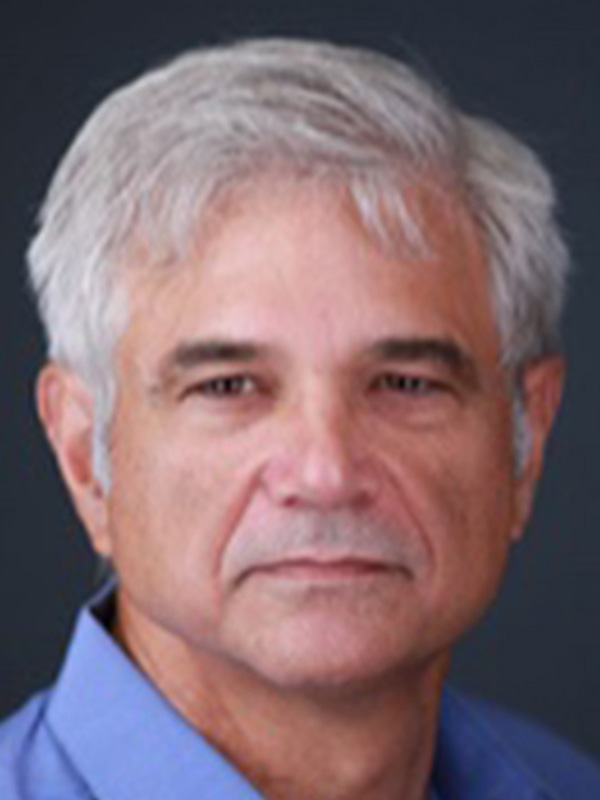
 Byron James Morrison Santangelo died earlier this spring, in Bloomington, Indiana at age 62. He was a beloved father, husband, friend, and teacher, whose original and insightful scholarship profoundly shaped post-colonial ecocriticism, African Studies, and the environmental humanities, and whose personal kindness, wit, charm, and unflinching loyalty made him the very best friend and colleague one could ever wish to have.
Born in 1961 in Queens, New York, Byron spent his early childhood in Binghamton, NY and Washington, DC. His family moved to La Mesa, CA in 1967 where he began a life-long love of the ocean: swimming, diving, and, above all, surfing. He graduated from Claremont McKenna College with a BA in English in 1984 and earned his PhD at the University of California-Irvine in 1993. He began his career at DePaul University in Chicago, then taught at the University of Kansas in Lawrence from 1997-2021, and ended his career at Indiana University-Bloomington.
Byron had a zeal for living, and he delighted in the exploring the world. Beginning in early childhood he traveled widely, living for extended periods in Finland, Italy, Portugal, Greece, and Hawaii. During graduate school he embarked on around-the-world airplane ticket, taking a formative, mostly solo, trek, which brought him across Asia, Oceania, and Europe. In Papua New Guinea, armed with only a handful of contact names, he paddled alone up the Sepik River in a canoe, exploring the culture and landscape and purchasing masks in the villages from artists who had crafted them using traditional materials. This journey deepened his already considerable love for art, and these pieces took a prized position in his vast collection of masks and sculpture from Oceania and Africa.
Byron was a fierce advocate for equity, a rigorous teacher and colleague, and an innovative scholar. A deeply committed intellectual, he insisted on pursuing an argument through to its fullest truth, while remaining a profoundly respectful listener, open to the words and experiences of others. Above all else, Byron was driven by an insistence on social and environmental justice, devoting himself to the struggle against institutional structures and historic processes that privileged some, as they discounted the lives and humanity of others.
Writing primarily as Byron Caminero-Santangelo, Byron’s work on African ecocriticism forged new avenues of research, blending his expertise on the study of literary form and rhetoric with his commitment to environmental activism. His scholarship was wide-ranging, with articles and book chapters mapping out themes and ideas that extended the lines of argument proposed in his two pathbreaking monographs, African Fiction and Joseph Conrad: Reading Postcolonial Intertextuality (SUNY, 2005), and Different Shades of Green: African Literature, Environmental Justice, and Political Ecology (Virginia, 2015) which was named a Choice Outstanding Academic Title and a finalist for the ASLE book prize in Ecocriticism. In recent years he had turned to the study of creative nonfiction, emphasizing the role of storytelling in shaping our understanding of the climate crisis. This project blended his investment in the importance of narrative with his concern for the devastation of global heating on human and nonhuman life, and Byron was exploring a literary path forward through his suggestion that climate nonfiction is “an art for our time.”
His teaching was a model of the craft, and both students and colleagues benefited from his boundless generosity and compassion. Over the course of his career, he won multiple university teaching and mentoring awards, inspiring lifelong devotion from his students. His work on environmental issues and decolonial studies shaped the lives and scholarly trajectories of countless graduate and undergraduate students, as well as conversations with colleagues around the world. His prodigious scholarship and devoted teaching was matched by devoted service to the larger field, serving, for example on the MLA Executive Committee for the Ecocriticism and the Environmental Humanities Forum from 2016-2021, as a valued member of the ASLE Executive Council, and in 2013 as site host of the 10th ASLE Biennial Conference at the University of Kansas. (Though “Site Host” hardly does justice to Bryon’s work on that conference—I was President of ASLE that year, had just come to KU from Florida State, and for unforeseen logistical reasons the conference had to be moved from its original location to KU eleven months before it was scheduled to begin. Byron’s incredible dedication and network of friendships throughout the university quite literally made that conference possible.)
In 2021, Byron moved with his wife Sara Gregg to Bloomington, where they began teaching at Indiana University. There he found a like-minded community of postcolonial and ecocritical scholars, when late in his second semester he was diagnosed with a rare cancer, Pancreatic Acinar Cell Carcinoma. Treatments sapped his considerable strength, and ultimately, he taught at IU for only one academic year. Nevertheless, he long outlived the doctors’ prognosis due to his incomparable grit and steadfast determination to live life to its fullest.
Of all the ways Byron impacted the lives of others, his greatest imprint was on his family. He enjoyed raucous family dinners, poker games, walks, and trips. He was the beloved husband of Sara Gregg and the devoted father of Nicola Santangelo, Anton Santangelo, Thomas Gregg Hayes, and Caroline Gregg Hayes. He cherished his brother Whitney Santangelo (Beatrice). Byron placed great care into the relationships he nurtured over the decades, including his co-parenting partnership with former wife Marta Caminero-Santangelo. There will be no replacing him; his loss is all our loss.
Byron Santangelo Memorial Writing Prize in Environmental Humanities
This prize celebrates the life and scholarship of Byron Santangelo, Professor of English and Environmental Studies at KU from 1997-2021, and renowned interdisciplinary scholar whose work brought together postcolonial and ecocritical scholarship in ways that profoundly influenced the study and teaching of the environmental humanities. One graduate and one undergraduate prize for scholarly essays concerned with topics in ecocriticism, humanities-based environmental studies, climate change, and/or environmental justice. Submit a writing sample of between 5-25 pages; open to all students at KU.


