

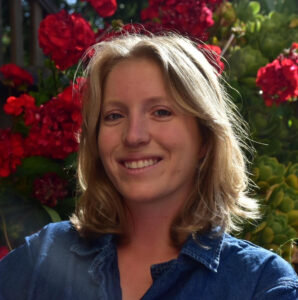
 ASLE’s Scholar of the Month for June 2024 is Alison Maas.
Alison Maas is a PhD. Candidate in English with a Designated Emphasis in Critical Theory at the University of California, Davis. Her work has appeared in The Routledge Companion to Politics and Literature in English, Atlantic Studies, and Comparative American Studies. She is creator and producer of the podcast series “California’s Eroding Coastline” funded by the Bilinski Fellowship at Bodega Bay Marine Lab, co-editor of the Searchable Sea Literature website run by Williams Mystic, and co-organizer of the UCHRI funded working group “Coast as Crisis: Narratives, Ecologies, and Politics of the California Coast.” She is currently serving as guest co-editor for the special issue “Regionalism’s Climates” in American Literary Realism. Her research focuses on early twentieth-century transatlantic literature, global shipping infrastructure, political theory, and coastal-ecological crises.
How did you become interested in studying ecocriticism and/or the environmental humanities?
I became interested in ecocriticism as an undergraduate at Vanderbilt University while I was working on an essay about Virginia Woolf’s To the Lighthouse for a modernist novel class with Professor Jonathan Lamb. During my research on the oceanic imagery in the novel, Professor Lamb introduced me to an emerging field he was working within called “ocean studies.” The first two articles I read as part of my research were in the 2010 PMLA “Theories and Methodologies” ocean themed cluster– Hester Blum’s “The Prospect of Oceanic Studies” and Patricia Yaeger’s editor’s column “Sea Trash, Dark Pools, and the Tragedy of the Commons.” Having grown up in Massachusetts and spending the summers with my grandmother in Maine, sailing or working on the water, I’ve always had a deep love for the ocean on a personal level. I was more interested in English literature than the sciences as a student though and never thought that I’d be able to work on the ocean as an English major, let alone as part of my profession. Discovering that there was an entire field of academic study devoted to oceans that wasn’t a part of a scientific field blew my undergraduate mind. Once I decided to apply to graduate school, I realized that the part of oceanic studies that interested me the most was its environmental focus; the ocean I knew as a child was already starting to show the effects of anthropogenic climate change. Patricia Yaeger wrote in her column:“Oceanic ecocriticism$ draws on narratives about the ocean in a state of emergency, a crisis that demands unnatural histories written by unnaturalists who limn the fleshy entanglement of sea creatures, sea trash, and machines.” I realized that I wanted to apply to graduate programs not only to study the ocean but also the effects of climate change more broadly. I am beyond grateful to have landed at UC Davis and become part of an amazing program with faculty who not only work in environmental humanities but are also hikers, outdoor lovers, and environmentalists in their own lives.
Who is your favorite environmental artist, writer, or filmmaker? Or what is your favorite environmental text?
I have about a million favorite environmental artists and texts but for the sake of this I will pick a few! One of my favorite films I’ve seen in recent years is Allan Sekula’s The Forgotten Space (2013) which chronicles the invisible labor and infrastructure of container shipping. While not necessarily a forwardly environmental artist per se, Sekula brings the material and imaginary geographies of the capitalist system to the fore in The Forgotten Space. What I find so interesting in his filming is how he shows where capitalist systems create and hide the entanglement of peoples, sea creatures, and machines, as Patricia Yaeger calls it. His work has especially challenged my own perception of the sea and port-cities having grown up in the northeast where the image of maritime labor tends to rely on a romanticized view of seafaring past. Another environmental text that I’ve loved since I was a kid, a favorite children’s story in Maine, is Barbara Cooney’s picture book Miss Rumphius (1982). The book follows Alice’s journey from a young woman who travels the world and then as an older lady settles in a house by the sea. Alice is later known by the town as the Lupine Lady because she scatters lupine seeds throughout her community to fulfill the task her grandfather told her she must do to “make the world more beautiful.” This book has stayed with me as a reminder that contributing even the smallest thing to one’s community can have a lasting impact that reverberates through future generations. Lastly, I’ve recently started teaching The Man with the Compound Eyes (2011) by Wu Ming-yi which is an ecological parable about the impacts of climate change that specifically re-imagines the Great Pacific Garbage Patch as a moveable island. I’ve had students who tell me they struggle with reading breeze through the novel and then later report that it resonated with them, which to me is the mark of a great environmental text!
What are you currently working on?
I’m currently working on my dissertation project, Literature’s Eroding Coast, 1870-1956, which examines representations of coastal erosion in early twentieth century American literature. My project ties the contemporary coastal erosion crisis to a longer historic, aesthetic, and narrative process that was brought about by the rise of steamship globalization and that I argue made space for a new coastal literary engagement at the start of the century. This upcoming year, I am excited to be working on the “Storms” chapter in The Bloomsbury Handbook to the Blue Humanities edited by Steve Mentz, Mohammed Muharram, Serpil Oppermann, and Sandra Young. I’m also especially thrilled to be collaborating with my dear friend and brilliant colleague Grace Hayes this summer on an article that explores the ecological, political, economic, and artistic forces of construction and deconstruction within the 1960-80 Emeryville Mudflat Sculptures. We can’t wait to do some environmental humanities “field work” playing in the Nor Cal coastal mud!
What is something you are reading right now that inspires you, either personally or professionally?
Right now, I’m re-reading Herman Melville’s Moby Dick as part of an informal reading group composed of two UC Davis English department faculty, Liz Miller and Mike Ziser, and three graduate students, Grace Hayes, George Hegarty, and Ava Bindas. Moby Dick has been one of my lifelong favorite books and is, of course, a foundational text in maritime literature. Since my last full read of the novel in high school, I’ve mainly re-read it in snippets for classes and more extensively when composing a book review of Richard King’s Ahab’s Rolling Sea during my second year of graduate school. This is the first time since high school, I think, that I’ve read the book from cover to final page in one sitting with my academic brain turned off. For the first half of the book (we’re still working our way through it!) I’ve been reading on a blanket in a local park, on a beach in Point Reyes, and in my bed to fall asleep. Making my way through a book with so much critical discourse surrounding it and pretending like I’m reading it for the first time has been an amazing experience. It’s been so refreshing to sit and discuss the text like a newcomer, noticing silly moments and remembering what it was like to read a classic like Moby Dick for the first time. I’ve also recently been reading Candace Fujikane’s Mapping Abundance for a Planetary Future: Kanaka Maoli and Critical Settler Cartographies in Hawai’i (2021). I heard Candace speak a year or two ago and have admired her work since. I often think about her idea that capital fears abundance and therefore mapping abundance is a powerful force for decolonial futures. Some of my favorite environmental humanities works, like Mapping Abundance, shift my thinking as a scholar but also as someone living-in and moving through the world.
Is there a scholar in the field who inspires you?
I am endlessly inspired by scholars in the field and feel incredibly lucky to be a part of a department at UC Davis filled with amazing environmental humanities scholars. Hsuan Hsu, Liz Miller, and Margaret Ronda have all influenced my work greatly. Beyond contributing incredible work on atmospheric disparity, extraction ecologies, and eco-poetics respectively to the environmental humanities, I’ve often looked to their mentorship as a guide for how to be an equally kind and giving scholar. I’ve also long admired many critical ocean scholars: Steve Mentz, Elizabeth DeLoughrey, Hester Blum, Melody Jue, Alison Glassie, to name a few. I am also endlessly inspired by the current and recent graduate students I meet at conferences and symposiums who are increasingly activist in their approaches to environmental humanities. Many work in the Land Back movement, in labor organizing, and environmental justice work within and beyond the academy, a task that proves to be an ongoing balancing act. They consistently remind me what it means to commit oneself to putting the environmental humanities into practice.


