

ASLE’s Scholar of the Month for February 2025 is Siobhan Angus. 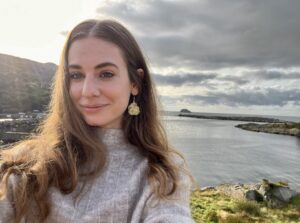
Siobhan Angus works at the intersections of art history, media studies, and the environmental humanities. Her current research explores the visual culture of resource extraction with a focus on materiality, labor, and environmental justice. She is an assistant professor of Media Studies at Carleton University and holds a Ph.D. in Art History and Visual Culture from York University where her dissertation was awarded the Governor General’s Gold Medal. Prior to joining Carleton, Angus was the Banting Postdoctoral Fellow at Yale University. She is the author of Camera Geologica: An Elemental History of Photography, (Duke University Press 2024) and her research has been published in Capitalism and the Camera: Essays on Photography and Extraction (Verso, 2021), Environmental Humanities, and October. At the heart of her research program lies an intellectual and political commitment to environmental, economic, and social justice.
How did you become interested in studying ecocriticism and/or the environmental humanities?
I got into the environmental humanities through my interest in labor history. The exploitation of human labor and natural resources went hand in hand. Industries grew and expanded by extracting raw materials as well as energy—whether from workers or from the earth—and that had serious consequences for both people and the environment. Resource extraction, whether it’s mining, logging, or farming, is tied to environmental harm. But the people doing that work are also affected by the environmental conditions they live and work in, whether through health risks, displacement, or unfair labor practices. This connection between labor and the environment led me to ecocriticism and the environmental humanities, and I wanted to explore how history, culture, literature, and art all deal with these issues. And through that, I’ve come to realize how much environmental challenges are tied to social and political struggles and how storytelling can help us understand and address the relationship between people and the planet.
Who is your favorite environmental artist, writer, or filmmaker? Or what is your favorite environmental text? Why?
There are so many environmentally engaged artists doing really exciting work right now. Recently, Kirsty Robertson and Sarah EK Smith curated an excellent show The Air of the Now and Gone at the Carleton University Art Gallery that has been really generative for me. The artists in the show move beyond both apocalyptic doom and uncritical optimism to embrace an ambivalent, nuanced, often humorous, and sometimes surprising approach. Some standout work includes Maude Arès’s elemental installation Le dedans de ce qui fuit (La gravité organise les hasards) and Niloufar Salimi’s drawings of poison ivy. While poison ivy is a human irritant, Salimi’s work highlights its crucial role as a food source for wildlife, underlining its significance in sustaining ecosystems. In terms of texts, Mike Davis’ work, particularly in Late Victorian Holocausts and Ecology of Fear, is the kind of writing I continually return to. Davis was incredibly influential in shaping my approach to environmental questions. What I find especially compelling about Davis is his ability to anchor his analysis in the local, with a focused attention to the lived realities of communities, while simultaneously connecting these local experiences to broader, global forces. His scholarship moves so deftly between scales, offering a model for politically engaged work that refuses to ignore either the intimate or the global dimensions of societal struggles. In many ways, his writing serves as a blueprint for a kind of scholarship that is both rigorously analytical and deeply empathetic, rooted in a commitment to social justice and historical materialism.
What are you currently working on?
I have two main projects on the go which build from my previous work on photography and extraction. I am currently working towards a series of exhibitions based on my book, Camera Geologica: An Elemental History of Photography. Taking a research-creation approach rooted in collaboration and community engagement, the exhibitions seek to address the historical and local specificity of histories of extraction, centering mining regions as sites of creativity, knowledge production, and activism. By challenging the tendency to flatten or metaphorize extraction, this project reimagines the traveling exhibition as a local and iterative process, rooted in dynamic, evolving dialogues between artists, curators, and communities. By examining the environmental, ethical, and financial implications of extraction in artistic practices—such as the use of materials, carbon emissions, and corporate sponsorship—the project aims to develop methodologies for curating exhibitions that question extractive practices, particularly within the framework of environmental justice. I am also collaborating with Jennifer Raab on a project tentatively titled What Lies Beneath an Empire: A Visual History of Guano, Bones, and Rock that focuses on the visual culture of fertilizer extraction in the nineteenth century United States. Settler colonialism remade the ground during the nineteenth century and relied on prints, paintings, and photographs to make visible the work of claiming land, defining property, and determining value. At stake was not only who the land was for, but what it was meant to do. Accordingly, the project addresses the geography of American expansionism both above and below ground to trace the histories of environmental racism, exploited labor, and its imbrications with visual culture.
What is something you are reading right now (environmental humanities-related or otherwise) that inspires you, either personally or professionally?
I’ve been gifting Kohei Saito’s Slow Down: The Degrowth Manifesto to everyone I know. It’s a provocative and engaging read that raises essential questions about how we live, work, and relate to the planet. The book challenges the notion of endless growth and calls for a fundamental shift in how we define progress and success. We’re constantly bombarded with the idea that more is better, but Saito encourages us to reconsider that narrative and focus on what truly matters—living a meaningful life that goes beyond consumption and productivity. Slow Down has helped me reflect not only on big societal issues like decarbonization but also on my personal day-to-day priorities. It’s been a valuable guide in rethinking what’s important and how I can slow down and align my actions with a more thoughtful, intentional way of living. Decarbonization and other crucial environmental shifts aren’t just about what we’ll have to let go of; they’re also about what we have the opportunity to build collectively.
Is there a scholar in the field who inspires you? Why?
Warren Cariou has had a profound impact on my work. A faculty member in the Department of English, Theatre, Film & Media at the University of Manitoba, Cariou is not only an accomplished scholar but also a filmmaker and photographer. I encountered his photographic work early in my PhD journey, and his practice really shaped my understanding of extraction. The first chapter of my book Camera Geologica focuses on Cariou’s petrographs made with bitumen from the Athabasca tar sands and they function as metaphor and method for what follows in the rest of the book. These pieces are not only visually stunning but also offer a thoughtful material engagement with bitumen which he uses as a light-sensitive material. Through his photographs, Cariou addresses the complex histories and land relations that underpin extraction practices in the region, drawing attention to the impact of industrial processes and settler colonialism on both the environment and local communities. Through Cariou’s lens, I’ve come to understand how extraction continually reverberates through our personal and collective histories.
But I would be remiss to only name one person, as Jess Varner of the University of Pennsylvania has been an incredibly generous interlocutor, as my research has shifted toward chemical histories. In addition to her ground-breaking work on the chemicals industry, she is also deeply involved in collective work with the Environmental Data & Governance Initiative and A People’s EPA. She offers a blueprint for engaging with environmental justice as both an analytic and a practice of building better worlds.


