

By Serena Ferrando. University of Toronto Press, 2026.
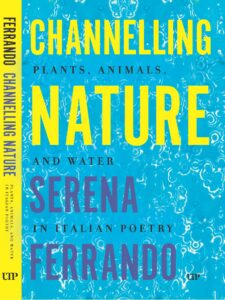
Channeling Nature: Plants, Animals, and Water in Italian Poetry offers a new understanding of 20th-century Italian literature by showing how poetry serves as a vital medium for ecological thought. Ferrando examines the work of poets such as Andrea Zanzotto, Daria Menicanti, and Milo De Angelis, to reveal how verse gives voice to the more-than-human world—plants, animals, waterscapes—while modeling forms of multispecies cohabitation, resistance, and care. Moving beyond traditional symbolic readings, this book emphasizes how poetic language channels the agency of natural forces and participates in shaping environmental sensibilities. Drawing on ecocriticism, environmental humanities, and Italian literary studies, Ferrando brings together close reading and interdisciplinary reflection to illuminate the ethical, aesthetic, and philosophical stakes of engaging with nature through poetry. Structured around key ecological elements—plants, animals, and water—the book shows how Italian poetry expresses layered connections between the human and nonhuman, often in overlooked or surprising ways. At the heart of this study is the claim that poetry, precisely in its marginality and slowness, creates space for a different mode of ecological attention: one grounded in empathy, attunement, and imaginative possibility. Channeling Nature invites scholars and students of literature, environmental humanities, and Italian studies to rethink the role of poetry in reimagining human relationships with ecosystems and other species. It affirms that literature’s aesthetic and affective power can deepen our understanding of planetary interdependence and help us imagine more sustainable ways of living and knowing.
Serena Ferrando is Assistant Professor of Environmental Humanities and Italian at Arizona State University. Her research bridges modern and contemporary Italian literature, the environmental humanities, and digital humanities, with a focus on poetry, multispecies studies, and urban ecologies. Her work has appeared in ISLE Interdisciplinary Studies in Literature and Environment, Ecozon@, Italian Culture, Italica, Humanist Studies & the Digital Age, Rivista di studi italiani and the volumes Italy and the Ecological Imagination, Ecocritical Theories and Practices and Landscapes, Natures, Ecologies, Italy and the Environmental Humanities, and Quaderni d’italianistica. She created and directs Navigli Project, a digital humanities interactive exhibit on Milan’s aquatic geographies. Ferrando was named the Scholar of the Month in October 2023 by the Association for the Study of Literature and Environment.


