

By Serpil Oppermann. Cambridge University Press, 2023.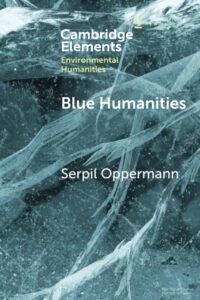
By drawing on oceanography (marine sciences) and limnology (freshwater sciences), social sciences, and the environmental humanities, the field of the blue humanities critically examines the planet’s troubled seas and distressed freshwaters from socio-cultural, literary, historical, aesthetic, ethical, and theoretical perspectives. Since all waterscapes in the Anthropocene are overexploited and endangered sites, the field calls for transdisciplinary cooperation and encourages thinking together beyond the conventions of tentacular anthropocentric thought. Working across many disciplines, the blue humanities, then, challenges the cultural primacy of standard sea and freshwater narratives. From the start, its aim was to provide disanthropocentric discourses about water ecologies. Engaging with the most pressing problems the world’s salt and freshwaters are facing today, this Element contributes to those new discursive practices from a material ecocritical perspective. My hypothesis is that fluid storied matter can bring together the telluric and aqueous existence.
For more, visit: https://www.cambridge.org/core/elements/abs/blue-humanities/B95115121CBA76A908DD6BDE8B320D6F
Serpil Oppermann is Professor of environmental humanities and director of the Environmental Humanities Center at Cappadocia University. Oppermann has served as the 7th President of EASLCE (2016–2018) and is one of the signatories to the “World Scientists’ Warning to Humanity: Second Notice” (2017) and the “World Scientists’ Warning of Climate Emergency” (2020). She has written extensively on postmodern, posthuman, new materialist, and ecocritical theories, and with Serenella Iovino, she helped develop material ecocriticism, an ecocritical theory that she continued to expand on, further exploring the expressive creativity of everything that is more-than-human in the intersections of science studies and the environmental and blue humanities. She is also a member of the Advisory Council of METI (Messaging Extraterrestrial Intelligence– http://meti.org/advisors) and the Turkish Ambassador in the SLSAeu (European Society for Literature, Science and the Arts-the sister organization of the international, USA-based Society for Literature, Science, and the Arts– https://www.slsa-eu.org/governance.html). Oppermann is the author of Ecologies of a Storied Planet in the Anthropocene (West Virginia UP, 2023), which explores the nonhuman storying of the Earth in the Anthropocene. She is the editor and co-editor of seven collections and over 100 essays and articles on ecocriticism and environmental and blue humanities. Among them are Material Ecocriticism (Indiana UP, 2014), Environmental Humanities: Voices from the Anthropocene (Rowman & Littlefield, 2017), both co-edited with S. Iovino, and Turkish Ecocriticism: From Neolithic to Contemporary Timescapes (Lexington Books, 2021), co-edited with Sinan Akıllı.


