


Paul Huebener. McGill-Queen’s University Press, 2024.
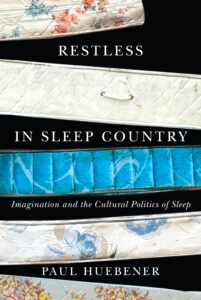
Sleep, and the lack of it, is a public obsession and an enormous everyday quandary. Troubled sleep tends to be seen as an individual problem and personal responsibility, to be fixed by better habits and tracking gadgets, but the reality is more complicated. Sleep is a site of politics, culture, and power.
In Restless in Sleep Country, Paul Huebener pulls back the covers on cultural representations of sleep to show how they are entangled with contemporary issues. The book features comments about sleep disruptions caused by climate disasters and global heating, alongside studies of representations of sleep in environmental fiction and art. By guiding us through this imaginative landscape, Huebener shows us how to develop a critical literacy of sleep.
Paul Huebener (he/him) is a professor of English at Athabasca University. His research focuses on critical sleep studies, critical time studies, and the environmental humanities, particularly in the context of literatures in Canada. His previous book, Nature’s Broken Clocks: Reimagining Time in the Face of the Environmental Crisis, was a finalist for the Alanna Bondar Memorial Book Prize for the Environmental Humanities and the ASLE-UKI Book Prize for Ecological Creative Writing.
PRASE FOR RESTLESS IN SLEEP COUNTRY
“Restless in Sleep Country is an exceptional book – insightful, original, entertaining, thought-provoking, and refreshing! Huebener takes the reader inside the world of sleep treatments and sleep therapy while also deconstructing the neoliberal advertising rhetoric that goes into marketing these things. This is a gently written yet hard-hitting study. I will never think of sleep in the same way.”
—Cynthia Sugars, University of Ottawa“Restless in Sleep Country exemplifies ‘the importance of the humanities in investigating concerns that are usually assumed to belong to the realms of science, technology, and consumer capitalism.’ Huebener shows how sleep is not just a biological process, but a space from which we negotiate our use of time, the value of our rest, and the social conditions that impact these rights.”
—Montreal Review of Books


