

ASLE’s Scholar of the Month for March 2025 is John MacNeill Miller. 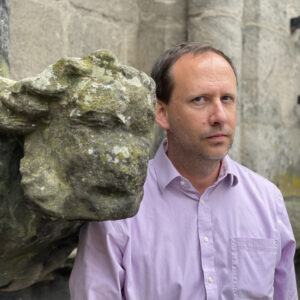
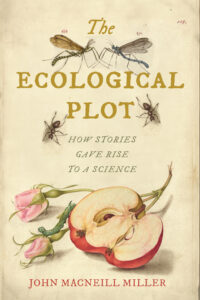
John MacNeill Miller is currently Associate Professor of English at Allegheny College, where he teaches and writes about the intersections of literature, animal studies, and the environmental humanities. His book The Ecological Plot: How Stories Gave Rise to a Science was published in 2024 by the University of Virginia Press. He has published academic articles in PMLA, Victorian Studies, and Environmental Humanities, among other venues. His public-facing essays and creative writing have appeared at outlets such as Public Books, Electric Literature, Flyway, and The Millions.
How did you become interested in studying ecocriticism and/or the environmental humanities?
I was supposed to be a scientist. For as long as I can remember, I’ve loved animals—I grew up in a family that included two cats, a giant Irish Wolfhound dog, and a very smart but very sassy parrot. That love of animals eventually grew into a broader fascination with the natural world. I decided to make it my life’s work and become a biologist. But when I got to college, I discovered that I didn’t find our memorization-intensive science lectures particularly rewarding, and I had little interest in the lab-oriented tasks I was being trained to perform. Much of the curriculum was geared toward microbiology, too, which didn’t help. It all seemed rather abstract and tangential to the hands-on relationships with plants and animals I cared so much about. I decided that everything I loved about science I could learn on my own from reading textbooks, science journalism, and the like; the coursework felt extraneous. In English classes, on the other hand, I was learning to think critically and ask questions about the world and my place in it—I was discovering modes of analysis that were richly rewarding, but that I would never have come up with on my own. So I downgraded my biology major to a minor and decided to focus on literary studies instead. When I eventually landed in graduate school, I learned about the environmental humanities for the first time. I was shocked that there was this emerging interdisciplinary field that actually studied science and environments and animals through a literary lens…a field that would let me combine all my passions in one unified pursuit! I was hooked.
Who is your favorite environmental artist, writer, or filmmaker? Or what is your favorite environmental text? Why?
Algernon Blackwood, a British writer of horror and “weird fiction” from the early 1900s, is probably my single favorite environmental author. Many of his stories—especially “The Willows” and “The Man Whom the Trees Loved”—are all about becoming enchanted with the natural world. But instead of insisting on nature’s benevolence, or even its knowability and comprehensibility from a scientific perspective, Blackwood’s stories obsess over the mysterious otherness of nonhuman life. They alternate between mystical wonder at nature and a dawning horror at the idea that other creatures are beings whose experiences and desires are finally inaccessible to us. H.P. Lovecraft described him as “the one absolute and unquestioned master of weird atmosphere.” Blackwood was quite popular and successful in the first half of the twentieth century, then fell into relative obscurity after his death in 1951. He’s been enjoying a revival in the past decade or two, with new editions of his work being published and a growing critical interest in his techniques and his historical influence.
A close second for my favorite environmental author—and someone far more famous in environmentalist circles—is a very different writer, albeit one who also insisted on both the wonder and final unknowability of natural systems: Aldo Leopold, the forester and game manager who helped pave the way for modern environmental ethics. Reading his book A Sand County Almanac had a profound effect on me in college, and Leopold features prominently at the beginning and end of my own recent book.
 What are you currently working on?
I put so much of the last decade into my book that this is a tough question! It’s also tough because I recently made the decision to leave my faculty position at the end of the 2024–25 academic year and try something new. I’m excited about that—it will give me more time to write, among other things—but it also means I won’t enjoy the same ready access to scholarly resources you have when you’ve got borrowing privileges at a college library. I have several conference papers I would still like to flesh out into articles in the near future. One is about a zany duo of late Victorian bird photographers, the Kearton brothers, and the way their popular books opened a window onto birds’ perceptions of the world around them—what the zoologist Jakob von Uexküll would have called the birds’ Umwelten. Another one of my working papers reconsiders Thomas Hardy’s classic novel Tess of the d’Urbervilles as an early, mostly unconscious foray into what would eventually (after the publication of Carol J. Adams’s The Sexual Politics of Meat a century later) become known as vegan-feminist theory.
But those are both short projects. If I can successfully navigate the library access issue when my academic employment ends, I’d really like to write a public-facing scholarly book on the way literary structures like plotting and metaphor undergird both science itself and current practices of scientific communication. I’ve taught an interdisciplinary introduction to Literature and Science built on these ideas several times now, and I’m starting work on a manuscript that would get those ideas out into the wider world. As someone who wanted to be a scientist and was seduced away by the humanities, I have a deep commitment to bridging the supposed chasm between literature and science—the division that has produced what the scientist-turned-novelist C. P. Snow famously called “the two cultures.”
That said, I’m also open to pursuing that mission via other, less scholarly roads. I’m very interested in the ways that creative writing can do the work of scholarship by other means. For me, part of the fascination of Algernon Blackwood and other weird fiction writers is the way they use horror stories to raise pointed philosophical questions about the limitations of human knowledge. I’ve published a few short pieces of weird writing both fictional (a story called “Mudpuppy Run” at The Hopper) and nonfictional (an essay called “Consider Her Ways and Be Wise” at Peatsmoke) that experiment with this scholarship-by-other-means approach, and I’ve been drafting a series of scientifically grounded bird poems that do similar work, four of which have been published various places.
In one sense, then, my work is very much up in the air at the moment. In another sense, though, it is deeply grounded in a specific interest and it has a clear sense of direction: whatever published forms it takes, it will be invested in reuniting literary and scientific modes through explorations of the ways they already overlap.
What is something you are reading right now (environmental humanities-related or otherwise) that inspires you, either personally or professionally?
I’ve been reading a lot of philosophy of science recently, both for my own edification and because—when it’s done well—it’s absorbing and thought-provoking at the same time. I’ve recently read or reread several of the classics in the field, works like Thomas Kuhn’s The Structure of Scientific Revolutions and Paul Feyerabend’s Against Method. The Feyerabend is especially stunning: he had an incredibly personal and often flippant voice that pushes at the limits of what scholars are supposed to sound like when they engage with serious ideas. I felt both grateful and sort of bereft when I finished Against Method. It left me with a rare sense of having to say goodbye to a voice I’d come to love, a sense that I normally only get after finishing a monumental masterpiece of a novel.
A more recent philosopher of science whose writing I’m finding really inspiring is Vinciane Despret. Her book Living as a Bird reviews the history of scientific analyses of birdsong, exploring how we arrived at the general consensus that much birdsong is essentially a possessive and territorial act—despite how beautiful and calming it sounds. Despret uses the history of science to throw this consensus into question, highlighting alternative interpretations and features of birdsong that can’t be fully accounted for when we understand it through an exclusively aggressive lens. I’ve finished Living As a Bird and am currently working my way through her compendium of essays What Would Animals Say If We Asked the Right Questions?, which offers short, energizing bursts of insight along the same lines as her bird book. In each mini-essay Despret focuses on one scientific fact, experiment, or truism and reconsiders the cultural, historical, and philosophical dimensions of the episode in question. It’s inspiring because every chapter reminds us of how we tend to receive information about animals and nature as unquestionable givens. We rarely think very hard about who reached such conclusions, why, and what kinds of assumptions might be baked into them—or what other interpretations might be possible. The book is generative and provocative, a nice reminder of how literary and humanistic skills can enrich and enliven scientific approaches to nature—it feels like both an inspiration and a goad to think further and write further in those directions.
Is there a scholar in the field who inspires you? Why?
There are so many inspiring scholars in ecocriticism and the environmental humanities! When it comes to ecocriticism, my particular subfield of Victorian literature was a bit late to the party. Precisely because much of Victorian literature focuses on an urban, industrial modernity that relegates nature to the sidelines, Victorianist critics did not take to environmental readings as quickly and readily as did scholars of, say, Romantic poetry or nineteenth-century American literature. So one big inspiration for me has been the group of Victorianist critics who began jumpstarting such discussions almost ten years ago, publishing work and arranging panels about Victorian ecologies under the collective name of Vcologies. Taken together, the work of the Vcologies collective has inspired me to think hard about how ecology was a vital concern even in an era when very few writers and thinkers were explicitly focusing on matters we’d consider environmentalist today.
Outside of my own subfield, two scholars who really inspire me are Ursula Heise (a past President of ASLE!) and Bénédicte Boisseron. Heise’s work has helped me realize how much supposedly “objective” scientific and environmentalist writing is structured by unacknowledged, but extremely powerful literary conventions of narrative, genre, and mode. Her close-readings in Imagining Extinction, which tackle everything from popular environmentalist literature to the IUCN methods for categorizing at-risk species, are always at the back of my mind. They serve as invaluable reminders that ecocritical methods don’t need to be limited to texts of historical, academic, or literary interest. They can be applied much more broadly, and they can play a vital role in helping us understand and act on information we receive from science and from contemporary culture.
Boisseron works on a similarly broad range of texts, shuttling effortlessly between past legal precedents, current journalism, and political philosophy to reconsider both the history and the future of intersectional justice across species. Her analyses in Afro-Dog: Blackness and the Animal Question have helped me think through our political present as a moment arising from networks of power that put distinct kinds of pressure on specific racial, economic, and interspecies relationships. A deep dive into these structures of oppression and injustice can be disturbing. Nevertheless the book leaves me with a sense of hope and of directions for ongoing political action. Its careful consideration of the historical connections between the treatment of dogs and the treatment of Black human beings in the West suggests surprising alliances and new paths forward—potential ways of remedying at least some of the messes we’re in.
Different as their subjects may be, then, I feel compelled to single out Heise and Boisseron as inspirations for the ways they rove across a wide variety of texts and histories, applying sophisticated theory and analysis to urgent cultural concerns—all the while managing to write in accessible and even stylish prose. That is, I think, the gold standard for scholarly work, and both of them exemplify it.


